Categories
Editorial

Please play Peggle, not Papa Pear Saga

papa pear saga peggle ripoff
Peggle, the vastly superior game that Papa Pear Saga completely ripped off

I’ve heard a lot about Candy Crush Saga but consider myself lucky to have not been sucked into it’s hateful world of Ripping Off PopCap’s Bejewelled So It Can Sell As Many IAPs As Possible, and I have to admit I kind of look down my nose at people who haven’t been as fortunate as myself. I see them on public transport and in coffee shops, addicted to the tacky-looking rip-off, and wish I could just lean over and point them at any one of the huge range of Bejewelled clones out there that bring something new to the party. I’d be doing them a favour.

I guess the appeal is that it’s free; apparently the majority of the smartphone-owning public can afford hundreds of $$$ for their phone but won’t pony up a couple of bucks for a proper game experience, happy (and miserly) enough to make do with a freebie that perpetually puts up a barrier to their enjoyment unless they grind a few more gems or wait for a dumb timer to run out or pay an expendable fee or hassle some friends on Twitter or Facebook. Eurgh. What’s wrong with paying the one-time asking price for a proper game experience, people?

The other day I saw an advert on TV for the follow-up to Candy Crush Bejewelled Rip-Off Saga, something called Papa Pear Saga, and in keeping with King.com’s business plan as established by Candy Crush, Papa Pear Saga is another blatant rip-off of a PopCap game, Peggle, a genius videogame amalgam of old-school pastimes like pachinko and bagatelle and a game so wonderful and successful that it’s been ported to pretty much every modern gaming platform in the known universe.

Papa Pear Saga is Peggle with cheap graphics, cheap music, clumsy controls and empty level design. But of course they’ve thoughtfully made sure to hinder that ripped-off gameplay with timers, social-media pestering, and expendable IAPs, and the public has predictably been lapping it up.

peggle ripoff papa pear
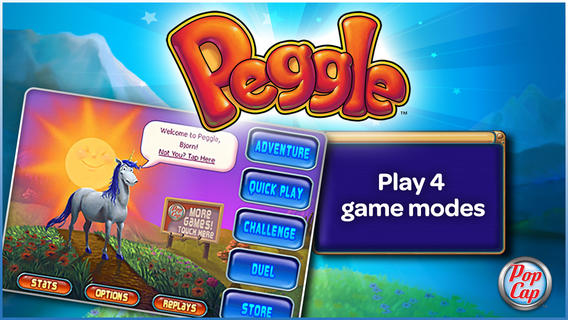
Look at all those reasons to play Peggle instead of hateful rip-off, Papa Pear Saga!

Please don’t play Papa Pear Saga, and please don’t ever pay them one penny of the ransom they demand to let you continue playing. Please take a moment to look at Peggle. See the price? That putting you off? In exchange for that one time fee you’ll get masterful entertainment from one of the greatest casual game studios in the world, PopCap. Peggle has been honed to perfection. Anyone can play it, and it’s an absolute delight from start to finish. There’s even a sequel or two. And you’ll never, ever have to cough up expendable gems to progress, or wait for a dumb timer to elapse, or have to avoid tapping the IAP Shop button – because there isn’t one.

Please buy Peggle. It will love you for you, not for the size of your wallet. Papa Pear only loves you for your idiotic tendency to buy gems in return for permission to keep playing.

PS: There are indeed many games that copy the Bejewelled-style Match-3 gameplay, and I don’t lay the ‘rip off’ accusation at their door. Why? Because they bring something else to the party, a new twist of some kind. But most of all, they don’t just release games as Trojan Horse style vehicles for their hateful IAP bullshit. That’s the biggest issue here, beyond King.com’s dearth of game-design creativity of course.

Categories
How-Tos iOS & Mac how-tos

Fiz Brewery Management: Tips & Strategies

I do rather love a craft beer (my brewery of choice: Scotland’s BrewDog) so Fiz: The Brewery Management Game ($1.99) recently made its way onto my iPad. As a fan of both unusual craft beers and the Kairosoft classic Game Dev Story (which this very closely models itself on), this looked like it could be right up my street, a brewery management game with no infuriating IAPs. So despite having opened my new PS Vita just hours before, by the evening of Christmas Day I was several virtual months into running FizzBat, my new virtual brewery.

Pretty quickly I discovered the need to strategise, particularly after that cocky swine Blumbrau beat me in a competition to win a bigger brewery. You can’t just churn out whatever colourfully monikered beer takes your fancy and flog it to any old shop, you’ve got to actually plan for the seasons (both sports and weather) and get it into the right shops, priced to beat out the competition but still turn a profit. Um… you did research the competition, right?

So I’ve been making a mental list of Fiz Brewery tips and tricks and thought I’d share. If you’ve come up with any strategies of your own feel free to leave them in the comments and I’ll add them to the list!

  • Pause the game – if you’ve ever played Faster Than Light (PC or Mac, superb spaceship management game) you’ll know the value of pausing constantly. The first release version of Fiz auto-pauses just once, when you finish a batch, but when you select to sell it time starts again. This behaviour might be made more sensible in a forthcoming update but for now – remember to pause All The Time! It’s easy to get distracted and forget that as you’re dilly-dallying over this IPA or that American Wheat, this tiny beer specialist or that massive supermarket, time is ticking away. Pause!
  • Always be brewing, queuing or selling – time passes constantly, and time is money! If you’ve not got a batch on the go, one enqueued, and at least one on sale, you’re doing it wrong!
  • Level up the correct skills – you should assign brew jobs based on who has the highest appropriate skill levels for each job. When staff level up make sure to spend the points on those pertinent skills, or occasionally on their Craft score. There’s no benefit to spreading points amongst their other skills if they’re not using them in their regular brew job.
  • Skill points versus Craft points – as well as Skill scores, each staff member also has a ‘Craft’ score that you be increased when staff level up. When brewing a new batch the total Craft points across your team are pooled and made available to spend on ‘Yield’, ‘Speed’ and ‘Quality’. However, if you’re planning on pouring all your Level Up points into Craft so you can spend them all on ‘Quality’ it’s worth noting that according to the developer “the way it’s set up, increasing your employee’s required stats for their job will improve their Quality better than increasing their Craft and spending that point on +Quality in the Brew Menu would.” For this reason, I’d advise focussing on getting your staff highly trained in their particular brew role before putting points into their Craft score.
  • At the start go for ‘Yield’, not ‘Quality’ – in the initial stages of the game you just need to make money to stay afloat, and the best way to do that is eke every last penny of potential profit from each batch by pouring all your craft points into ‘Yield’ and not ‘Quality’. And for the most part you can completely ignore ‘Speed’ until you’ve got a few more Craft points to play with.
  • Easy money at the Bodega – whenever you run out of money the game tosses enough ingredients your way to make a quick batch of the bog-standard lager, Grubb’s Lite, and the Bodega owner waives his stocking fee. So if you’re getting started, or you’re flat broke, brew up some Grubb’s Lite, spend the Craft points on the highest yield possible, and flog it all at the Bodega for around 15 coins for a profit of around 350-400.
  • fiz brewery strategy

  • Plan for the seasons – work out what your go-to Summer, Winter and in-between beers are and around 10 months before you’ll need them start on at least one batch to go into storage in readiness. For example, the Surf Shop – once this opens it’s an almost guaranteed summertime money maker, a boon for beginners in the early stages of the game. It’s only open for a few months from month 6 each year, and their customers really like summery lager, so make sure you have batches of Get Off My Lawn on the go from month 10. Get them into storage, then come month 6 send them to the Surf Shop, price them right and they’ll fly off the shelves over summer, netting a huge profit to pour into new beers.
  • Don’t necessarily always sell full batches – proud as you are of your 100-unit batches, the shops you sell to may not have the space to stock them, or enough customers who prefer that type of beer to buy them all within the two month shelf-life. Refer to the research and consider splitting the shipment.
  • Research! Research! Research! – there’s no two ways about it, you need to do research on your customers and your competition. I always select 50 customers (for more detailed results) over four weeks (because it’s cheapest) and I select both customers and competition the first time.
  • Buy & research new retailers in advance – unless you like spending all your profits on costly Instant Research you’ll want to research a new retailer before you’ve got a batch ready to sell there. Buy into new retailers is while batches are brewing, and run research on them immediately. Then when a batch is ready you’ll have all the relevant info about the new shop at your fingertips.
  • fiz brewery tips

  • Refresh your customer research – competitor research only needs to be done once per shop/market and updates itself monthly after that. Customer research goes out of date over time, however, so remember to occasionally run more customer research at the shops you sell to most in case customer tastes have changed significantly. Start research as soon as you buy into a new retailer, and buy into a new retailer at least a month before you’ll want to sell there.
  • Undercut the competition – if there are competing brands of a similar style at the shop you’re sending your new batch to, look at their quality and their markup. Unless your quality is significantly higher, don’t set your markup higher than theirs.
  • Make whatever the competition ISN’T selling – check to see if a beer type popular at any given shop is actually in stock from your competitors; if it’s not, get your own version in there as soon as possible while there’s no competition!
  • Don’t waste money on stiff competition – the game will warn you if you’re trying to sell in a shop that stocks competitor beers with a far higher Quality score than yours. However, as a rule if your beer Quality score is in the lower third of the range for the competition then don’t bother selling unless you’re willing to seriously undercut them (and throw away potential profit).
  • What’s the recipe for (insert beer here)? – all the recipes are randomised every time a new game is started, so you can’t just start making the best ones cribbed off a Wiki page 😉
  • Finally, don’t forget the mice! – if you find yourself with a spare moment while a batch brews, check out the brewery screen and tap the mice that run across from time to time, they’re always carrying something valuable!
Categories
iOS & Mac reviews

Coffitivity review: perfect for working from home

coffitivityCoffitivity is a free app that recreates the ambience of a coffee shop with three different audio tracks to match the mood you want to create. It’s completely free and available for iOS, Mac and Android, or you can load up coffitivity.com in your browser and play the sounds from there. And it’s had a huge impact on my ability to focus when working from home, so I highly recommend it.

FOCUS!

I’m a freelance photographer so I should be good at focussing, right? Ba-dum-TSH, here all week folks, try the veal.

Seriously though, I spend a lot of my free time kicking around the house either relaxing with Netflix or a game, doing chores, or, most problematically, studiously avoiding doing chores. When I’m on a job somewhere, surrounded by other people also working, I have zero distraction issues but at home, alone, in silence, I have a serious problem with procrastination and distractions, particularly when it comes to doing certain computer tasks.

I recognise my procrastination and avoidance issues and I’ve got a number of tools and personal processes to combat them: I’ve made jotting down anything I remember I need to do in Things much more of a habit, meaning I can stop worrying about what things I might have forgotten to do and just get on with doing them; I keep our budget spending updated daily using the YNAB iPhone app; I try to remember to turn off distractions like Safari, Mail and Tweetbot when I sit down to do computer work; and I keep an Rdio playlist of gentle jazz handy as background noise.

Turns out background noise has a much bigger impact on my ability to focus than I thought and reassuringly there’s scientific research backing this up. When I sit down to tackle something that needs to be done in the lonely silence of our flat my mind wanders and has a terrible habit of dredging up all sorts of negative emotions, drawing on past negative situations, and projecting negative futures, all of which scare me off making decisions and taking action by making me afraid of how I might fail, and how it’s easier to just avoid failure than it is to face up to the possibility of it occurring.

Pretty heavy, huh? Well that’s a post for another day. Right now I want to tell you about the simplest step that made the biggest difference to my focus and my mental attitude when I sit down to work: installing Coffitivity.

Coffee shop ambiance, at home

Music has always been my first recourse to silencing the silence of our empty flat, but that can be a distraction in itself. Do I want to put on the same old playlist? Find something new? But what genre? Nothing too pop, rock or dance. Nothing too atmospheric in case it’s depressing (so no Clint Mansell soundtracks then). I could spend half an hour idly flicking through Rdio, then hop onto Safari to research ‘work at home’ playlist suggestions… And before you know it I’ve run out of time allotted for the original task.

The ambiance provided by Coffitivity seems to let me get right into the task at hand, puts me In The Zone. I tried it for the first time a couple of days ago and spent the next five hours without distraction compiling the year’s expenses for my tax return, something I’ve been putting off since April. Sure, I had to do it this month anyway, but surrounded by other (imaginary) people all doing their own thing, working away and supping coffee and getting on with it, I got started and… enjoyed the process of working. It’s like a human version of ‘white noise’, that somehow keeps my brain marching forward following the map rather than wandering off into the shadowy forest of distraction.

The details

Once installed the app lives in the menubar. Click to reveal the drop-down menu, pick a track, set the volume and hit play. You can have it launch at login, and there’s a ‘one-click’ mode to play or pause whenever you click the menubar icon, with a right-click revealing the drop-down.

The icon itself is the coffee cup from the logo. It’s black and grey when not in use and turns a kind of aquamarine colour and presents a swirl of steam while a track is playing. I’d love an option to set it to black to match my other menubar icons, though.

The tracks are different enough from each other to suit various moods and are all long enough that the looping won’t start to grate. However, I noticed that when they looped it was a noticeably hard cut back to the beginning rather than a crossfade, which takes the sheen off the illusion somewhat. The University Undertones track in particular had a 1-2 second pause when it looped – ouch.

Still – it’s free, and these things can be fixed with small updates. All in all, while you may well be able to find similar background sounds in other ambience apps, Coffitivity does one thing and does it well. I’d love a more modern icon and would welcome a couple more tracks but those would just be an extra syrup shot in an already excellent cup of virtual joe. It works for me – I highly recommend it!

Download Coffitivity for iOS
Download Coffitivity for Mac

Categories
Apple Editorial

Why I won’t buy a TapTapTap app ever again

You may have heard that an App Store developer called TapBots recently did something inexcusably disgusting and utterly outrageous: after 30 months of free support and a free upgrade to Version 2, they dared to charge for Version 3.

Yes, I know. I know! What a cheek, eh? I mean seriously: developers shouldn’t be in the business of selling apps if they’re only in it to make money. They should be on the App Store purely for our benefit and for their own love of making apps and giving them away for free, not because they’re trying to run a business.

If selling the apps you poured the last few months of your life into is your plan, better find another way to make a living. Nobody pays for hard work these days AND NEITHER SHOULD THEY. Deal with it, idiots.

Just kidding!

If you found yourself nodding along in agreement with me there, here comes the twist: I disagree with all of that. I have no problem with a developer whose business model is to put a fair price on their work and ask me to pay for it if I like it. Obviously some users of the app disagree with that policy, even though it may be one of their most-used apps. That’s fine – Tapbots doesn’t need them because plenty of their customers are only too happy to put the same value on the work as Tapbots do. In fact, many of us would pay more.

Turns out that some dicks over at a developer called TapTapTap completely disagree. While disagreement is all good and well, in this case it’s surprising because they’re not in competition with Tapbots. Regardless, a simple disagreement is not enough for the dicks at TapTapTap. No, they decided it would be really cool to slag off Tapbots (well, okay, they don’t name them, but it doesn’t take Benedict Cumberbatch in a warm coat to work out who they’re referring to given previous jabs over Twitter) not only in a blog post, but in the update notes for their own app. Reeeaaal professional.

The dicks at TapTapTap

The dicks at TapTapTap make an app called Camera+. It’s not bad, a decent alternative to the stock camera app on the iPhone although most of what it does is baked into the iPhone anyway now, but for a long time their app had better features and it’s become a stalwart of the Photography section.

So their business model is this: they sell the app to a mass market for $2, update it forever for free, and offer IAPs in the form of filter packs. Yes, sodding filter packs. Well hey, a developer’s gotta eat, right? Well, no, not according to the dicks at TapTapTap, but I’ll get to that.

Tapbots on the other hand employ a marginally different business model: they sell their app to a niche market for $3 (currently on sale) and don’t sell IAPs. Bugfix-type updates are free, the huge update to Version 2.0 was free, but after 30 months of entirely free support (and no IAPs!) they charged $3 for Version 3.0.

Both these models are completely fair enough. I have no problem with either as both demonstrate a sustainable business model. And to be clear, ‘sustainability’ means making sure the revenue your business brings in will keep you in business. That’s pretty much the first rule of running a business, folks.

TapTapTap’s ‘arguments’

I’ve always suspected the guys at TapTapTap might not be the sort of people I’d go for a drink with, based on the update notes for their app. They’re definitely a bit more amusing than the average update notes, but they’re also a bit “hey we’re KRAZY”, with a K. A bit attention seeking. And I find attention seekers kinda dickish. So I’ve always had my suspicions.

This week John Casanta at TapTapTap was happy to confirm my suspicions by posting an app update followed by a blog post which pushed way past “Krazy with a K”, way past “I’m an attention whore!”. It basically says: “Developers that charge for updates are pathetic and hate their customers. Go us! And fuck Tapbots!”

I’m paraphrasing, of course. Here’s what it actually says, make your own mind up:

I’ve experienced both ends of the spectrum as a developer… I recall the early days where I’d earn less than $1,000 per month and essentially lived in a shack to make ends meet. And at the other end, I’ve made far more money than anybody needs to live. The bottom line is that absolutely none of this has any bearing on our customers.

If we, or any other developers aren’t able to make ends meet through selling our apps, the solution is neither to blame nor to screw over your customers. It’s more along the lines of: get better at what you do… or find some other work that better suits you.

Being able to get out of bed at noontime and work out of your home in your fluffy bunny slippers is a privilege, not a right. And you need to earn that privilege. A lot of developers seem to have lost that perspective these days and sound far more entitled than the people who support them by buying their apps that they accuse of being entitled.

If you’re a developer, it’d be nice if you actually thought all of this through in an objective way before just firing off the typical defensive, knee-jerk reaction.

Like I said: dicks.

This isn’t about developers with a lousy business plan not being able to make ends meet and screwing over their customers. This is about developers using a considerably underpriced version of the business plan serious developers making serious software tools have used since, like, forever: bugfixes are free; significant new releases have a fee. And if Apple actually offered upgrade discount pricing on the App Store perhaps we wouldn’t have the problem that’s emerged: that App Store customers unrealistically expect all app updates for free.

I’ve got to address some of the points in the blog post:

  • “If…developers aren’t able to make ends meet through selling [their] apps, the solution is neither to blame nor to screw over your customers.” – where to start? Firstly, where’s this “blame” coming from? Methinks this is just a little strawman that TapTapTap pulled out of their arselocker to make their flimsy point sound waaay better, as I don’t see any developers ‘blaming’ anyone except Apple for unhelpful pricing tiers.
  • Secondly, call me crazy, but I don’t think releasing an optional new version of your app at a reasonable price that reflects the work that went into it and the work that will continue to be put into it is screwing over your customers. I’m pretty sure Tweetbot 2 still works, because I’m still using it (I actually don’t like the design of Tweetbot 3, ironically).
  • Thirdly, because there’s just so much wrong in that one sentence, it’s pretty obvious that Tapbots are perfectly capable of making ends meet through selling their apps, because that’s what they continue to do: sell their app.
  • “Get better at what you do” – what does the quality of their coding have to do with anything? They’re already remarkable at what they do, which is why thousands of iPhone users bought their app in the first place.
  • “Find some other work that suits you” – presumably work that doesn’t involve being paid a fair and sustainable wage, because as we all know: charging fairly for your work = failing.
  • “Being able to get out of bed at noontime and work out of your home in your fluffy bunny slippers is a privilege, not a right.” – Jeez, what is it with TapTapTap and strawman arguments? Remember, we’re talking about the right to charge a fee for your work. Where you do that work is completely irrelevant. If anything, working from home in awesome fluffy bunny slippers is a more responsible and cost-effective move than working from an office, isn’t it? Try telling that to the dicks at TapTapTap, who perhaps wouldn’t need IAPs or to even charge for their app at all if they worked from home.
  • “A lot of developers seem to have lost that perspective these days and sound far more entitled than the people who support them by buying their apps that they accuse of being entitled.” – there’s nothing ‘entitled’ about saying “We’ve spent months working on a major update, we’re really proud of it, and it’s just $3.” Entitlement is this: “Waaaah! $3 for something I’ll use every single day for months if not years?! SO UNFAIR! I’m going to buy a different app instead.”. That’s entitlement.

The last word

What TapTapTap achieved with this post and app update was to reinforce the entirely misguided and unrealistic expectations of App Store users that developers should sell their work at rock bottom prices and then spend the rest of their lives working on the app for free, and hope for a sales spike.

Worse, they combined their airing of this rather silly position with a pretty nasty dig at non-competing fellow developers, using it as an opportunity to curry favour amongst the greedier and more selfish of their users who might find that sort of shit-stirring funny.

On TapTapTap’s About page is a list of their ‘important principles’. It includes the line:

  • High quality software doesn’t have to cost you a lot.

Come on, folks. $3 is not a lot of money. No, don’t give me “it’s a lot of money on the App Store” because for an app you’ll use hourly, daily, for months if not years, $3 is not a lot of money.

Similarly, a total of $6 over thirty months to support ongoing work on said app is also not a lot of money, and anyone who argues that it is while waving their $600+ iPhone around is as much of a dick as the guy that writes TapTapTap’s blog.

Perhaps TapTapTap should teach us by example and make a Twitter app without IAPs that’s anywhere near as good as Tweetbot, then demonstrate how the resulting revenue from that one app alone is enough to keep their company afloat forever. While they’re at it, I’d love to see them make their Camera+ IAPs free because as we all know, selling your work is such an insulting rip-off of your customers. Then they might have an angle on App Store business models that’s worth posting.

However, it probably won’t be worth actually reading if the maturity and professionalism in evidence on their blog is anything to go by. I’m happy to join the throng of folk on Twitter deleting Camera+ in disgust.

P.S.

Just before anyone points this out themselves with passive-aggressive glee: I’m fully aware that TapTapTap couldn’t give a toss who uninstalls Camera+. After all, they’ve already got our money, and their business model evidently works for them, just as Tapbots’ model is working for them. I also don’t expect them to give a toss about my opinion on their policies and business model. This post isn’t about making a stand against them or trying to bring them down a peg. It’s just about airing my opinion on my blog, for others to either agree or disagree.

Also, I’m sorry to anyone at TapTapTap whose opinions are not represented by the blog post in question. I’m sure you’re not all dicks, and I support your right to be paid for your work.
Categories
Apple Editorial

Why the hell do I have to pay again for Tweetbot 3?

pay again for tweetbot 3Tweetbot 3 is out, the latest version of what is definitely my favourite Twitter client, and certainly one of the very best available for iOS and OSX, but rather than it being a free update in the App Store for existing customers it’s been released as an entirely new app that you have to purchase. Yes, even if you already bought Tweetbot 1, or Tweetbot 2. And yes, even if you bought it the day before Tweetbot 3 came out.

(Okay that last one is a bit unfortunate if that happened to you, but sometimes shit happens. Like the time I bought Borderlands 2 on Steam the week before it was 70% off in a sale. Dammit.)

OMG WTF? i hav 2 like PAY AGAIN?

Yes, you do. And before we go any further let me just say, if you came here with your Whiners Are Winners hat on looking for some moral support you won’t find it here. That post title above lured you here so I can say:

If you like Tweetbot and want Tapbots to be able to keep developing it, support them by paying the tiny price they’re asking for this major new update.

(N.B.: in the originally-published version of this post the above sentence read: BUY IT, YOU CHEAP F*&£$ but I thought that might be a bit argumentative…)

I have no problem with this business model. It’s fair for Tapbots to ask a very small fee to cover months if not years of work not just ‘reskinning for iOS 7’ as many on Twitter inaccurately describe the update, but rebuilding the app from the ground up to take advantage of the oodles of new code going on under the hood of iOS 7. Not to mention that Tweetbot 1 to Tweetbot 2 was a free update as I recall, so the longer you’ve been enjoying Tweetbot the better the deal gets.

If you still don’t think it’s reasonable please make sure you stick around to the end of this post where there’s a short exercise in calculating exactly how much Tweetbot has cost you thus far. It’s an eye-opener.

Here’s what Tapbots had to say on their blog:

Seven months ago, we started working on a big update for Calcbot. We were hoping to release it sometime in the summer. Two months in, Apple announced iOS7 at WWDC. We knew this was a huge change. It would make every single one of our apps look dated so we had to make sure our flagship app was ready for it. All of the design work that went into the Calcbot update was rendered obsolete in one keynote and so we focused our energy on updating Tweetbot for iPhone. Playing with the beta of iOS7 over the next few weeks brought us to the realization that this would not just be a “re-skin”. We really had to just start over with the new foundation and concepts of iOS7.

Major updates like this one take time and effort. Months of hard work rebuilding it with new iOS 7 frameworks, redesigning the interface (there is no convenient ‘Reskin Now!’ button in X-Code that redesigns interfaces by magic, you know), and all the testing and refining that goes with that. Months of work. If they were to give that away for free they’d need to find a way of making the money you spent on the first version cover not just all the work that went into that version you originally bought, but this version too.

But those are the unrealistic customer expectations set up by the App Store practices that have emerged, and it’s not sustainable for many – this is how IAPs gained dominance, screwing up the balance and gameplay of so many otherwise fantastic games.

Meanwhile, on Twitter some Tweetbot fans feel ripped off:

  • “It’s just a reskin” or “It’s not a major new version” (it’s a complete rebuild and redesign within the new iOS 7 frameworks and design guidelines)
  • “All other apps are updating to iOS 7 for free” (actually, not all)
  • “I’m an acid (sic) supporter since day one but I’m not buying it again” (speaks for itself really)
  • “They should adapt to the App Store business model of making updates free” (Apple’s suggestion to those wishing to charge for major updates is to release it as a new app – but they don’t allow them to offer upgrade discounting)
  • “This is a SCAM and Apple should stop it” (urgh, always with the SCAM)
  • “Apple don’t charge for updates to iOS 7, why should I pay to update Tweetbot?” (Apple sells iPhones for hundreds of dollars and can afford to keep you sweet with free iOS updates. Tapbots’s business is selling Tweetbot)

And so on. I replied to a few of these sorts of tweets this morning and asked: do you work for free? At what point do developers start working for free? How much value have you had from the app?

Out of a couple of dozen who replied, some did laugh it off and agree that yes, put like that it was fair enough. The rest argued with me. Whether they worked for free was irrelevant, and Tapbots needed to find a better way to make money. One said that even though he “loves” Tweetbot he’s stopped using Tweetbot 2 simply because Tapbots dared to charge for Tweetbot 3, and is considering buying Twitteriffic or Echofon instead.

Mind = blown.

Apple is the problem; could IAPs be the solution?

The frustrating reality is that App Store customers are now used to ‘pay once, get free updates forever’ but this model came about not because it’s good business sense (because on the face of it it’s not) but because Apple decided not to allow traditional upgrade pricing in the App Stores, presumably in keeping with it’s policy of making things as simple as possible for the average user. In Apple’s opinion too many price-points = confusion. Just look at Microsoft’s Windows pricing levels.

I am not the average user. I’m used to a world where ‘point release’ software updates (mostly bug fixes) tend to be free but major release updates are paid. That is: version 2.3.2 to version 2.4 I would expect for free. But version 2.4 to version 3.0 I would expect to pay for. So while I certainly don’t complain about this ‘free updates’ thing that’s happened to the App Store, I’ve always wondered how sustainable that is.

Just guessing, but I reckon most serious App Store developers, especially those with a ‘utility’ app as opposed to a game, would prefer to adopt upgrade discounting, would Apple let them. I base that guess on articles around the web about how developers have struggled with Apple’s update pricing policy. Recently a major developer called Omnigroup tried to overcome Apple’s limitations with inventive and seemingly fair workarounds, only to have Apple shut their attempt down.

For an app that offers all updates for free, major or minor, IAPs offer the only real alternative revenue stream to fund ongoing development in the absence of a sales spike: either with expendable ‘currency’, most often used in casual games to speed up hatefully slow timers that restrict progress; or with extra content packs such as the extra filters in Hipstamatic, or extra gameplay chapters in The Walking Dead. Unfortunately the former is far more frequently used (and abused) than the latter, and the satisfaction of paying a fair price (i.e. over £4.99 at least) for a good game and not being nickel-and-dimed to play without interruptions is rare these days – although XCOM may have turned that tide.

Somewhere in the IAP system there lies the germ of a solution to upgrade pricing, whereby an app costs full price the first time you buy it but major upgrades are made available as IAPs at a cheaper rate, thereby offering existing users an upgrade discount. It seems like that could work but presumably there is some kind of issue with completely overwriting an app with an entirely recoded version as an IAP or it would already be happening.

How to rationalise it

If you still have a problem with developers maintaining a sustainable business by charging for the considerable efforts involved in major updates to their apps, and still believe that all updates should be free and that developers should find some magical beans or something to finance their work, here is an exercise that may help you at least rationalise the expense:

Q: When did you first buy Tweetbot?
A: (I bought Tweetbot 1 the week it launched in April 2011 – Tweetbot 2 was a free update, ironically)

Q: How many weeks is that?
A: (I’ve owned it 130 weeks)

Q: What price did you pay?
A: (I paid £2 I believe)

Q: Therefore, how much have you paid per week to own and use Tweetbot?
A: (£2 divided by 130 = £0.0153 = 1.5 UK pennies per week)

One and a half UK pennies per week. That’s what I paid to have both version 1 and version 2 of Tweetbot on my phone. And in fact after Apple’s cut I’ve only paid Tapbots £0.0107, barely a hair over one penny per week, to sustain their efforts not just maintaining the app with bug fixes but also rolling out an entirely new version 2.0 of the app.

So a whole new third version, entirely rewritten and redesigned for the new iOS 7 UI and frameworks, for just £2*?! I feel bad for them that it’s so cheap, frankly, and as I fully intend to continue using their app, I have no issue paying them for the hard work they put into it.

The last word

I was told on Twitter that Tapbots are lucky to have customers like me. What, I replied, you mean customers that understand why they’re asked to pay for their products? Fortunately, I think there’s more than enough people perfectly happy to pay way below the deserving rate for an awesome app for Tapbots to do just fine, but the miserliness of strangers continues to drive me up the wall.

app-store-download

* The price I’m quoting for Tapbots 3 is their discounted Launch Pricing.